July 3, 2026 · 7 min read
5 Signs You're Losing Hair Faster Than Normal
If you keep asking why is my hair thinning, the answer usually starts with patterns, not panic. These five signs help you separate normal shedding from a real change worth tracking.
The short version
- One heavy shower day does not mean your hair is falling out faster. A repeated change from your normal baseline matters more.
- The biggest early signs are more drain hair, a more visible crown, a wider part, a changing hairline, and weaker styling volume.
- Lighting, wet hair, oil, and haircut length can all make thinning look worse than it is.
- Weekly photos from the same angles are more useful than checking the mirror every hour.
- If the change keeps showing up in photos, it is time to track it seriously instead of guessing.
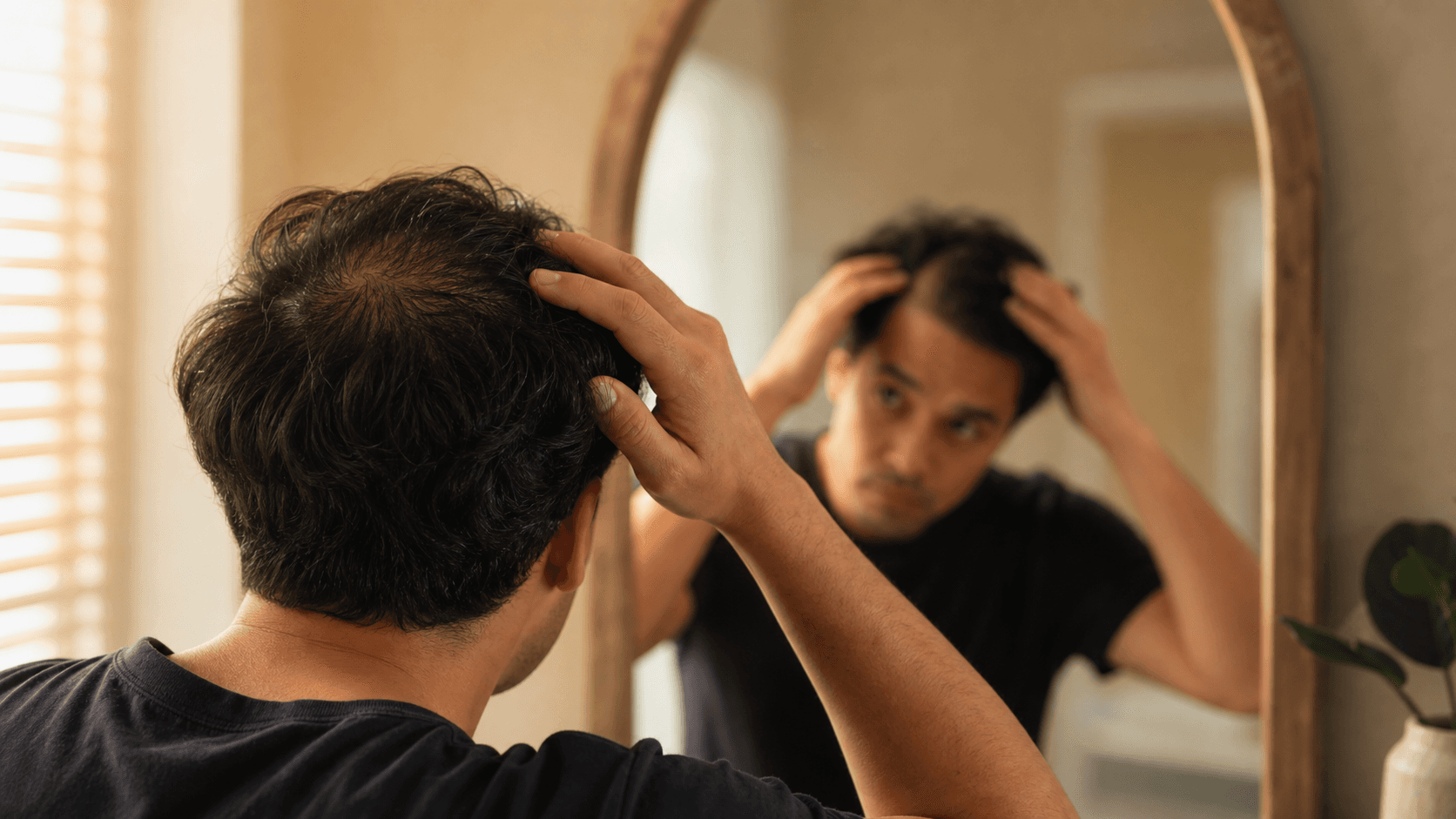
You probably noticed it in the most annoying way possible: a clump in the shower, a photo where your crown looked too bright, or a mirror angle that made your hairline feel unfamiliar. Then the question starts looping: why is my hair thinning, and how long has this been happening?
The hard part is that hair does not change in a neat, obvious way. It shifts slowly. One week can look normal. The next week, your usual haircut does not sit right. This guide will help you read the signs with more accuracy, so you can tell the difference between a bad hair day and a real pattern.
More hair in the drain only matters if it becomes your new normal
Drain hair is loud. It looks dramatic, especially if your hair is long, dark, curly, or you only wash every few days. A single heavy wash day can include several days of loose strands that were already ready to shed.
That does not mean you should ignore it. It means you need a baseline.
Start by asking a better question: is this more than usual for you? If the drain looks fuller every wash for several weeks, if your towel catches more strands than normal, or if your hands come away with hair each time you shampoo, that is a pattern worth tracking.
The mistake is judging every shower like a verdict. Hair naturally sheds. The useful signal is consistency over time.
Try this for two weeks: after each wash, rate the shedding as low, normal, or high. Keep it simple. No counting individual strands. You are looking for a trend, not a forensic report. If every wash lands in the high category, your hair is telling you something changed.
how much hair loss is normalYour crown looks different in regular photos
The crown is where people often get blindsided. You do not see it directly in the mirror, so the first clue usually comes from a photo taken from behind or above. Suddenly the swirl looks wider. The scalp catches more light. The area feels less dense than you remember.
Overhead bathroom lighting makes this confusing because it exposes the scalp on almost everyone. Wet hair does the same thing. So does oily hair that clumps together.
The real question is whether your crown looks more visible in ordinary conditions than it used to. Compare photos from the same kind of lighting: daylight by a window, the same bathroom, or the same bedroom mirror. Do not compare a harsh flash photo to a soft outdoor photo and call that evidence.
A useful crown check has three rules:
Use the same angle
Take the photo from slightly above and behind. Keep the camera distance consistent.
Use dry hair
Wet hair separates into sections and exaggerates scalp visibility.
Compare month to month
Weekly checks are fine, but month-to-month comparisons reveal the real direction.
If the crown keeps looking brighter or wider under the same conditions, the question is no longer "was that just the lighting?" It becomes "how quickly is this changing?"
crown thinning or hair partYour part is widening even when your hair is clean and dry
A part can lie. It looks wider when hair is greasy, flat, wet, or pulled too tightly. It also changes depending on how you brush it.
But if your clean, dry hair shows more scalp along the same part line than it did a few months ago, pay attention. A widening part is one of the clearest visual clues because it gives you a straight line to compare.
Look for the small stuff first. Maybe the part looks sharper near the front. Maybe it extends farther back than it used to. Maybe you keep moving your part to make your hair look fuller. Those adjustments feel tiny in the moment, but they are often how people compensate before they admit something has changed.
The best way to check is boring, which is why it works. Stand in the same spot. Use the same lighting. Part your hair the same way. Take one photo from above. Repeat weekly.
Do not judge it immediately after styling. Products can lift roots and hide density changes for a few hours. Look at your hair in its normal state, not its best five minutes.
Your hairline is changing shape, not just sitting differently
Hairlines are personal. Some are naturally high. Some are uneven. Some have a widow's peak. Some mature in early adulthood and then stay stable for years.
What matters is change.
If the corners are moving back, the temples look deeper, or your forehead seems larger in recent photos, your hairline deserves a closer look. The same goes for edge thinning around the front, especially if pulling your hair back shows more scalp than it used to.
This is where memory becomes unreliable. You will convince yourself it has always looked like that. Then you will find an old photo and realize it has not.
Use photos from six months ago, one year ago, and two years ago if you have them. Match the facial angle as closely as possible. A tilted head can make the hairline look completely different.
There is a difference between a stable mature hairline and one that is actively moving. A stable hairline looks similar across time. An active one keeps changing shape.
Your hair still covers your scalp, but it styles weaker
This is the sign people overlook because it feels less visual. Your hair might still cover your scalp, but it behaves differently.
Maybe it collapses faster during the day. Maybe your usual product feels too heavy. Maybe your hair looks fine from the front but flatter from the side. Maybe the same haircut suddenly needs more effort to look decent.
That kind of change can be a density signal. Hair volume comes from the number of strands, the thickness of each strand, and how those strands hold shape. When any of those shift, styling gets harder before the scalp looks obviously exposed.
This is why "why is my hair thinning" is not always answered by one dramatic sign. Sometimes the answer is a cluster: a bit more shedding, a slightly brighter crown, a wider part, and hair that no longer holds the same shape.
Track the styling change the same way you track photos. Write down what is different. Less lift at the roots. More scalp after styling. Hair separates faster. Product feels wrong. These details sound small, but they make the pattern clearer.
How to tell if the change is real
The best test is not panic-checking. It is repeatability.
Take the same four photos every week: front, crown, left side, right side. Use dry hair. Use the same lighting. Keep the camera at the same distance. Add a short note about your routine that week, especially if you changed products, washed more often, wore hats, used heat, or had a stressful stretch.
Then compare the full set after four weeks. Not day to day. Week to week.
That is how you separate noise from signal. One bad photo is noise. Four consistent photos showing the same direction is signal.
This is also where a tool like Morph fits naturally. The goal is not to stare at your hair more. It is to measure it in a repeatable way, so you stop relying on bathroom lighting and memory. You can join the waitlist here: Morph waitlist
track hair loss progressFrequently asked questions
Why is my hair thinning if I do not see bald spots?
Thinning usually starts before bald spots show up. You may notice weaker volume, a brighter crown, or a wider part while your hair still technically covers the scalp.
Is it normal to lose hair in the shower?
Yes, shower shedding is normal. It becomes worth tracking when the amount is clearly higher than your usual baseline for several washes in a row.
How do I know if my crown is thinning or just bad lighting?
Take crown photos in the same lighting with dry hair. If the crown looks more visible across repeated photos, the change is more likely to be real.
Can a widening part be temporary?
Yes. Wet hair, oil, product buildup, and how you brush your hair can all make a part look wider. A part that keeps widening under the same conditions deserves attention.
How often should I take hair progress photos?
Once a week is enough. Daily photos usually create more anxiety than clarity because hair can look different from lighting, styling, and wash timing.
What is the first thing I should do if I think my hair is thinning?
Start documenting it. Take consistent photos, note changes in shedding and styling, and look for a pattern over four weeks.
When should I get outside help?
Get help if the change is sudden, patchy, painful, itchy, or moving fast. Tracking is useful, but you should not ignore a change that feels extreme or uncomfortable.
Early access
Know exactly what's wrong with your hair
Morph scans your scalp with AI, gives you a Hair Health Score across 4 dimensions, and builds your personalised 12-week plan based on your actual results, not generic advice.
Join the waitlist →More from Morph
All articles6 min read
Best Apps To Track Hair Growth And Loss In 2026
The best hair growth tracker app is the one that helps you take consistent photos, compare the same zones, and understand whether your routine is actually changing anything. In 2026, tracking matters more than another folder of random camera roll photos.
6 min read
What Is A Hair Health Score And How Is It Calculated
A hair health score turns your hairline, density, thickness, and scalp condition into one trackable number. The useful part is not the score by itself, but how it changes over time.