July 7, 2026 · 6 min read
What Is A Hair Health Score And How Is It Calculated
A hair health score turns your hairline, density, thickness, and scalp condition into one trackable number. The useful part is not the score by itself, but how it changes over time.
The short version
- A hair health score is a structured way to measure visible hair condition instead of guessing from random photos.
- The best scores look at several dimensions, not one vague “good” or “bad” result.
- Morph uses four dimensions: scalp health, hair density, hairline, and thickness.
- The first score gives you a baseline. The real value comes from comparing future scans against it.
- A score should guide what to track next, not make you panic about a single number.
You already know the feeling. One photo looks fine. Another photo makes your crown look brighter than it should. A mirror angle makes your hairline look different from yesterday.
That is where a hair health score becomes useful. It gives your hair a baseline instead of leaving every mirror check up for debate.
The score is not magic. It is a structured way to turn visible clues into something you can compare: hairline shape, density, scalp visibility, thickness, and the condition of the scalp itself.
Here is what a good score should measure, how it should be calculated, and how to use it without obsessing over every point.
A score only matters if it measures the right things.
A single number can feel simple, but hair is not one single thing.
Your hairline can look stable while your crown gets thinner. Your density can look decent while scalp irritation makes everything look worse. Your hair can shed more for a few weeks without changing visible coverage. A useful score needs to separate those signals instead of flattening them into one vague grade.
Morph breaks the score into four dimensions:
- Scalp Health
- Hair Density
- Hairline
- Thickness
That matters because each dimension answers a different question.
Scalp health looks at the surface the hair is growing from. Density looks at how much coverage you have in visible zones. Hairline looks at shape and edge consistency. Thickness looks at how full individual strands and grouped hair sections appear.
If you only track one area, you miss the story. The score becomes useful when the pieces are separated first, then combined.
measure hair density at homeThe baseline matters more than the first number.
The first scan is not a verdict. It is a starting line.
Most people want the number to tell them whether things are “bad.” That is understandable, but it is not the best use of the first result. Hair changes slowly. Lighting changes fast. Styling changes instantly. A single result can tell you what the system sees today, but it cannot tell you the trend yet.
The baseline becomes useful after you repeat the scan under similar conditions.
If your score is 72 today and 73 next week, that does not mean much by itself. If it moves from 72 to 78 over several consistent scans, and the density and hairline dimensions also improve, that starts to look like a real trend.
The same is true in the other direction. One lower score is not proof something is going wrong. A pattern across multiple scans is what deserves attention.
This is the biggest difference between tracking and checking. Checking asks, “Does my hair look worse right now?” Tracking asks, “Is the same area changing over time?”
track hair loss progressThe calculation should reward consistency, not perfect photos.
No score is useful if the input is messy.
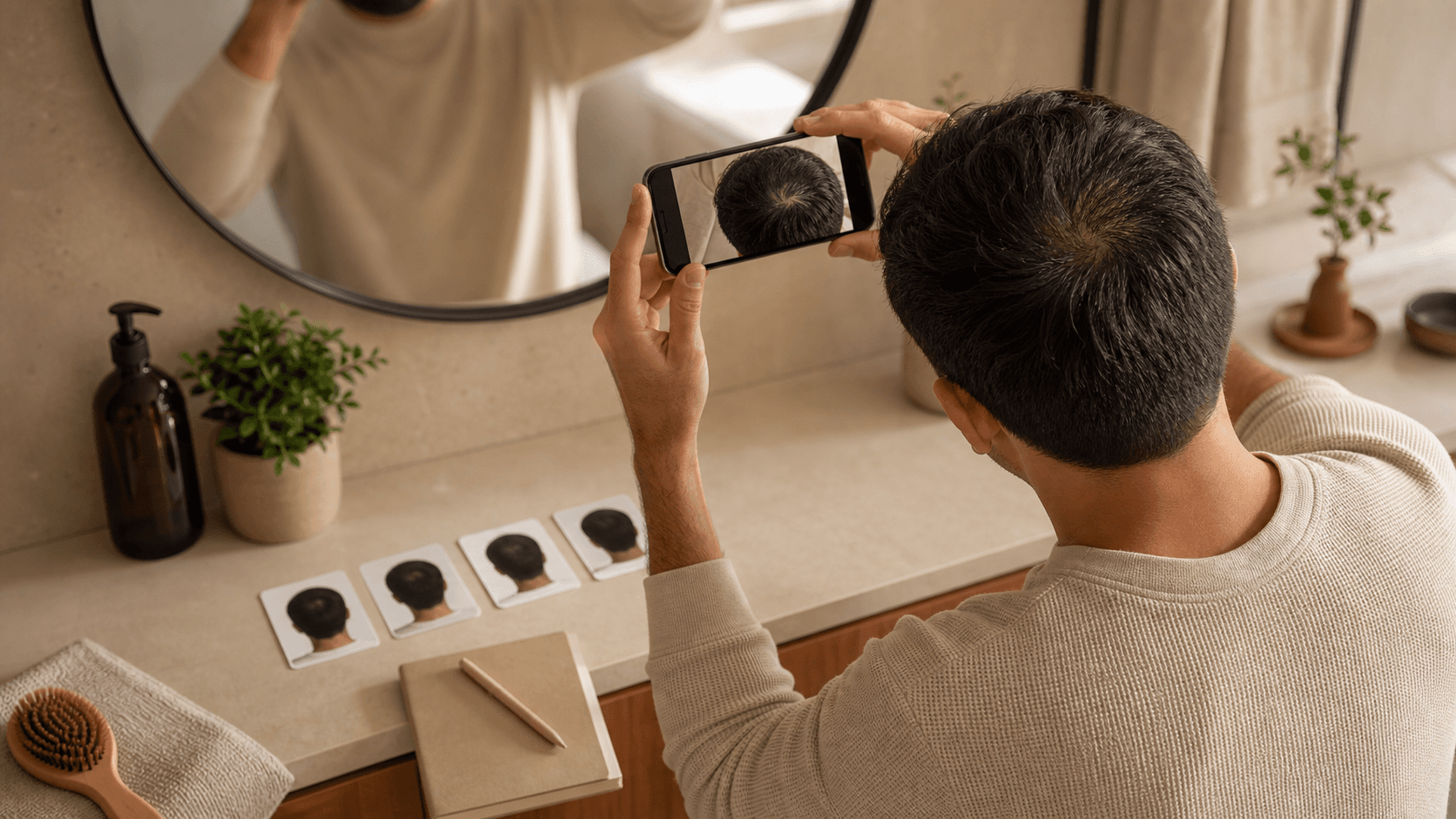
That is why a good scoring system needs guided photos. Random camera roll pictures are too inconsistent. One is taken under a bathroom light. One is taken after a workout. One is taken with wet hair. One is taken from a lower angle that makes the hairline look higher.
For Morph, the scan flow is built around four views:
- Front
- Crown
- Left
- Right
Those views are not random. They cover the areas where visible change usually shows up first. The front shows hairline shape. The crown shows density and scalp visibility. The side views show temple shape and asymmetry.
The score is then weighted across the four dimensions:
- Scalp Health: 30%
- Hair Density: 30%
- Hairline: 20%
- Thickness: 20%
That weighting keeps the score balanced. Density and scalp condition carry the most weight because they affect the overall visual impression. Hairline and thickness still matter, but they are interpreted as part of the whole picture.
A score should tell you what to do next.
A number without a next step is just another thing to worry about.
The point of the number is not to make you stare at a dashboard. The point is to help you decide what deserves attention.
If the density dimension is lagging, you need better photo consistency and coverage tracking. If the hairline dimension changes, you should compare the same front and temple angles over time. If scalp health is the weak point, you should pay closer attention to dryness, flakes, oiliness, and irritation triggers in your routine.
This is where the score connects to the plan.
Morph uses the scan to create a personalised 12-week routine. The routine is not a generic checklist. It is tied to what the scan sees, then checked again through weekly rescans.
The loop is simple: scan, score, follow the routine, scan again.
That is the part most people are missing. They try something new, then judge it from memory. A score gives you a cleaner way to ask whether the visible evidence is moving in the right direction.
hair routine thinning hairDo not treat the score like a personality test.
The score is useful, but it is not your identity.
Do not compare your number to someone else’s. Different hair types, lengths, colours, part lines, and lighting conditions can change what a scan sees. The only comparison that really matters is you against your own baseline.
Also, do not chase tiny changes. A few points up or down can happen from photo conditions alone. The trend matters more than the daily movement.
Use the score as a dashboard, not a judgment. It should make your hair feel less mysterious, not more stressful.
Frequently asked questions
What does the score mean?
It summarizes visible hair condition across several dimensions. A useful version looks at things like density, hairline, thickness, and scalp condition rather than giving one vague visual rating.
What is a good score?
A good score is the one that stays stable or improves from your own baseline. Comparing your number to someone else’s is not very useful because hair type, colour, length, and camera setup all affect the result.
How is Morph's score calculated?
Morph uses four dimensions: scalp health, hair density, hairline, and thickness. Scalp health and density each count for 30%, while hairline and thickness each count for 20%.
Can a score tell me if my hair is getting better?
It can help when you compare repeat scans over time. One scan gives you a baseline, while several consistent scans show whether visible coverage, hairline shape, or scalp condition is changing.
How often should I check my score?
Weekly is enough for tracking. Daily checking makes small lighting and styling changes feel more important than they are.
Is a score better than taking photos?
It works best with photos, not instead of them. The photos show the visible evidence, and the score helps organize that evidence into something easier to compare.
Early access
Know exactly what's wrong with your hair
Morph scans your scalp with AI, gives you a Hair Health Score across 4 dimensions, and builds your personalised 12-week plan based on your actual results, not generic advice.
Join the waitlist →More from Morph
All articles6 min read
Best Apps To Track Hair Growth And Loss In 2026
The best hair growth tracker app is the one that helps you take consistent photos, compare the same zones, and understand whether your routine is actually changing anything. In 2026, tracking matters more than another folder of random camera roll photos.
7 min read
Why Is My Hair Thinning But Not Falling Out
Hair thinning not falling out usually means the visible change is happening through density, strand thickness, styling behavior, or breakage rather than dramatic shedding. Here is how to tell what kind of change you are actually seeing.