June 30, 2026 · 7 min read
Why Is My Scalp Visible Through My Hair
Scalp showing through hair can be normal in harsh light, wet hair, or around a natural part, but it can also be an early sign of density change. The difference comes from repeatable photos and whether the same areas keep getting brighter.
The short version
- Seeing scalp is not automatically a problem. Parts, crowns, wet hair, and bright light all expose scalp.
- The real question is whether the same area looks more visible than it used to.
- Oil, product buildup, and wet hair can make hair separate and exaggerate scalp visibility.
- A wider part, brighter crown, and weaker styling volume together are stronger signals than one photo.
- Weekly photos in the same conditions are the cleanest way to tell noise from a real change.
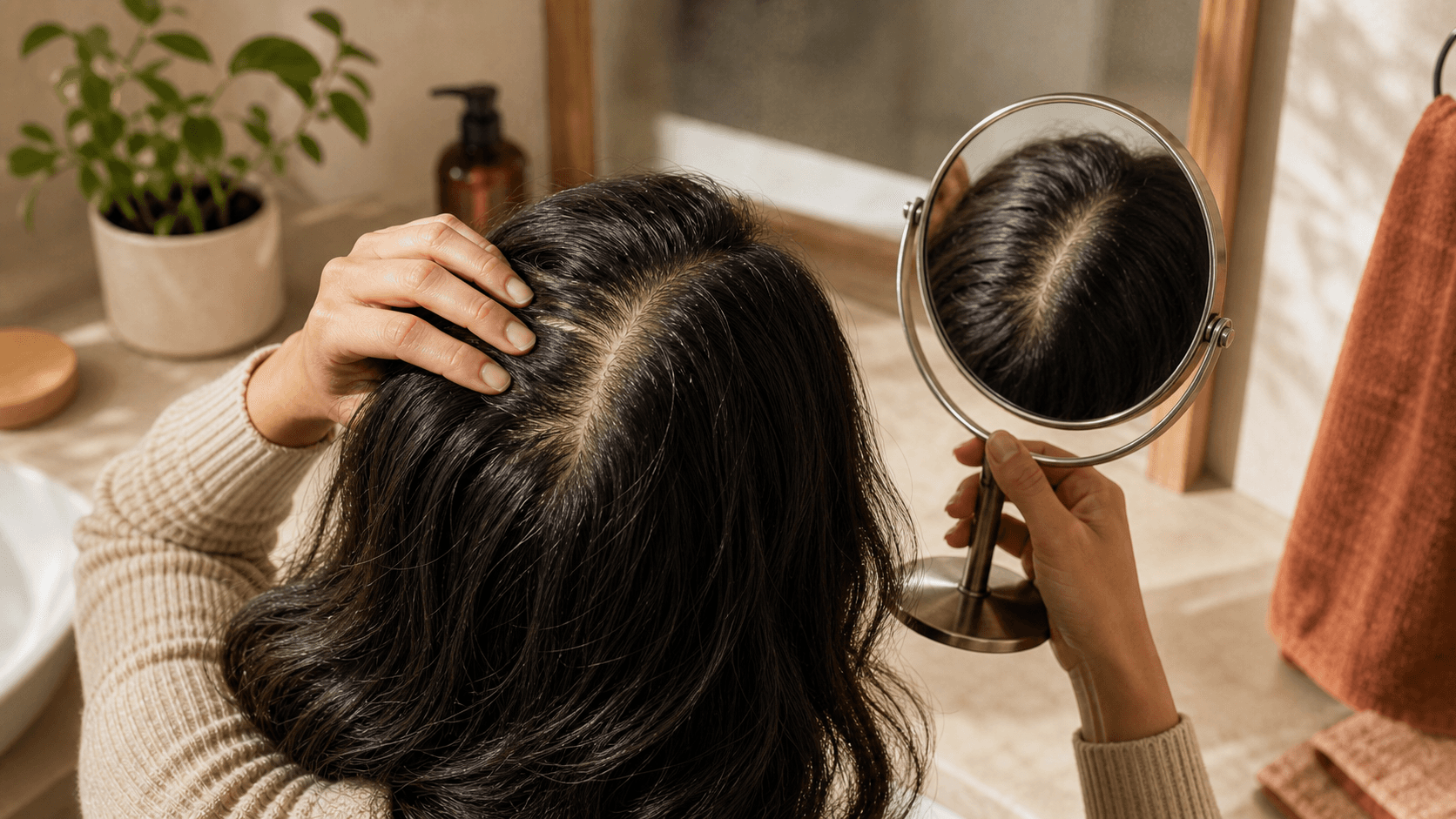
You tilt your head under the bathroom light and suddenly your scalp is right there. Not bald. Not dramatic. Just visible enough that you keep moving your hair around, trying to make it disappear.
Scalp showing through hair can mean several things. It can be a normal part line, harsh lighting, wet hair, oil, or a crown swirl doing what crown swirls do. It can also be an early sign that density is changing. The problem is that all of those can look similar in the mirror.
Here is how to separate a normal visibility moment from a pattern worth tracking.
Scalp visibility is normal in certain zones
Hair does not cover the scalp evenly everywhere. The part line naturally shows skin. The crown often has a swirl where hair changes direction. The temples can look thinner because hair grows at different angles there.
That means visible scalp is not proof by itself.
The part is the easiest example. If you create a clean part, you are literally separating the hair and exposing scalp. A bright bathroom bulb will make that line look sharper. Dark hair against a light scalp creates even more contrast.
The crown is similar. A natural whorl can show a small spot of scalp even when density is normal. If your hair is shiny, oily, or wet, the spot can look bigger than it is.
The useful question is not “can I see scalp?” The useful question is “does this look more visible than my normal under the same conditions?”
crown thinning or hair partLighting can make normal hair look thin
Bathroom lighting is rude. It sits overhead, hits the scalp directly, and creates high contrast between hair and skin. Phone flash is even worse because it flattens the scene and lights the scalp through any separation in the hair.
Outdoor sun can do the same thing. So can standing under a downlight at a restaurant, gym, elevator, or office bathroom. Those are not fair testing conditions.
To judge scalp showing through hair, compare like with like.
Use dry hair. Stand in the same place. Use the same light. Take the same angle. If your scalp only looks visible in one brutal lighting setup, the signal is weak. If the same area looks more visible in repeatable photos, that is different.
The goal is not to find the most flattering photo. The goal is to make the photo honest.
Wet hair, oil, and product can expose more scalp
Hair that clumps together shows more scalp between the clumps. Wet hair clumps. Oily hair clumps. Heavy product clumps. Even a conditioner that is too rich can make the roots separate and look flatter.
This is why your scalp can look obvious right after a shower or near the end of a long day, then look normal after your hair dries or after a wash.
Do not judge density when your hair is wet. Do not judge it when you have pushed the part around ten times. Do not judge it after a product-heavy styling day unless that is your normal baseline.
Check your hair when it is clean, dry, and sitting naturally.
If the scalp visibility disappears under fair conditions, it was probably an exaggeration. If it remains in the same area, especially across weeks, keep tracking.
hair thinning not falling outA wider part is different from a bright part
A bright part can be lighting. A wider part is a shape change.
Look at the width of the visible line, not just how shiny or bright it looks. Does the part look wider near the front? Does it extend farther back than it used to? Do you keep moving the part to hide the same exposed area?
Those are better clues than brightness alone.
The same logic applies to the crown. A bright crown photo can be lighting. A crown zone that keeps getting wider, flatter, or harder to cover is a pattern.
Use old photos if you have them. Look for the same angle, same hairstyle, and same lighting if possible. If you cannot find perfect matches, use what you have, but do not overread one bad picture.
Scalp showing through hair becomes more meaningful when the visible area is larger, not just brighter.
Track the pattern, not the panic
The fastest way to make this worse mentally is to check every mirror. The fastest way to make it clearer is to build a baseline.
Take four photos once a week: front, crown, left, and right. Add one part-line photo if that is your main concern. Use dry hair, same light, same distance, same angle.
Write one short note: clean or oily, freshly washed or not, product or no product, haircut recently or not. These details matter because scalp visibility changes with routine.
After four weeks, compare the set.
If the photos are stable, you have a baseline. If the part, crown, or temples keep getting more visible under the same conditions, that is a signal worth taking seriously.
Morph is built around repeatable tracking instead of random mirror checks. Guided scans capture multiple angles and turn them into a Hair Health Score, so you can see whether your baseline is changing. If you want a clearer way to measure it, you can join the waitlist here: Morph waitlist
track hair loss progressFrequently asked questions
Is it normal to see my scalp through my hair?
Yes, especially along the part, at the crown, under harsh light, or when hair is wet or oily. It becomes worth tracking when the same area looks more visible over time.
Why does my scalp show more in bathroom lighting?
Overhead bathroom light hits the scalp directly and creates strong contrast. It can make a normal part or crown swirl look much more exposed than it does in softer light.
Does wet hair make scalp visibility worse?
Yes. Wet hair clumps together, which creates gaps between strands and exposes more scalp. Use dry hair for a fair comparison.
How do I know if my part is widening?
Take photos from the same angle with clean, dry hair and the same part placement. If the visible line gets wider over repeated photos, that is more meaningful than one bright image.
Can oil make my scalp look more visible?
Yes. Oil makes roots separate and lie flatter, especially near the part and crown. Compare clean, dry hair before deciding the change is real.
Should I check my scalp every day?
No. Daily checking creates noise and anxiety. Weekly photos are better because they show direction instead of random lighting changes.
What should I do if the same area keeps looking more visible?
Start tracking the part, crown, hairline, and styling volume together. A single visible area matters more when it appears with other repeatable changes.
Early access
Know exactly what's wrong with your hair
Morph scans your scalp with AI, gives you a Hair Health Score across 4 dimensions, and builds your personalised 12-week plan based on your actual results, not generic advice.
Join the waitlist →More from Morph
All articles6 min read
Best Apps To Track Hair Growth And Loss In 2026
The best hair growth tracker app is the one that helps you take consistent photos, compare the same zones, and understand whether your routine is actually changing anything. In 2026, tracking matters more than another folder of random camera roll photos.
6 min read
What Is A Hair Health Score And How Is It Calculated
A hair health score turns your hairline, density, thickness, and scalp condition into one trackable number. The useful part is not the score by itself, but how it changes over time.