June 25, 2026 · 7 min read
What Your Hairline Shape Says About Your Hair Health
Hairline shape can tell you a lot when you compare it to your own baseline. Here is how to read corners, temples, widow's peaks, uneven edges, and changes over time.
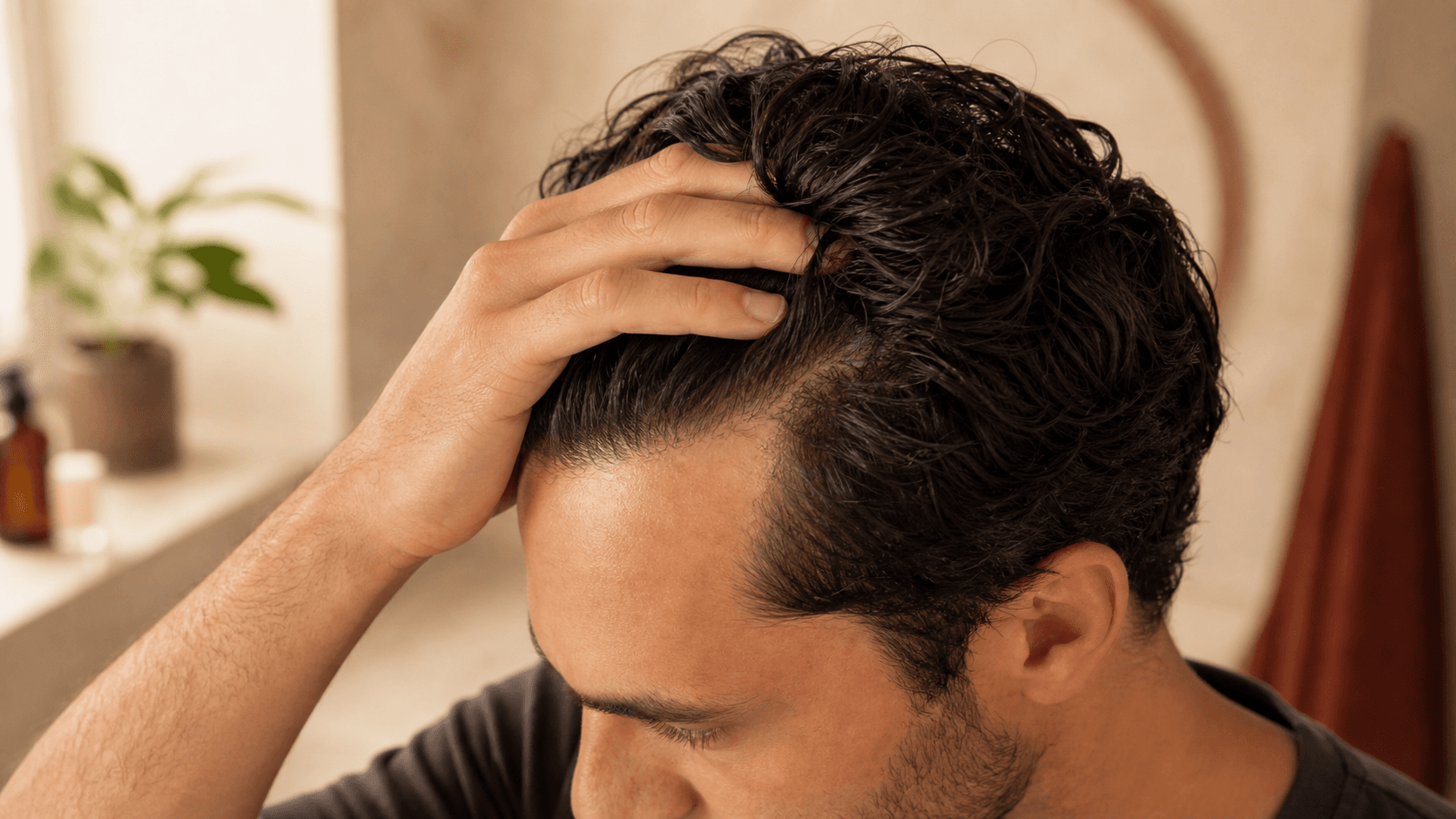
The short version
- Hairline shape matters most when compared to your own old photos, not someone else's forehead.
- Corners, temples, widow's peaks, and uneven edges can all be normal.
- A changing border is more useful than a single snapshot.
- Styling, lighting, haircut length, and wet hair can all make a hairline look sharper or softer.
- Track the same front and side angles monthly if you want a real answer.
Your hairline is one of the easiest places to obsess because it is right at the front. Every mirror shows it. Every selfie frames it. Every bad haircut seems to redraw it.
But hairline shape is not automatically good or bad. Some people naturally have a high hairline. Some have a widow's peak. Some have uneven temples from childhood. Some have a rounded front, some have a sharper M shape, and some have one side that sits higher than the other.
The useful question is not “is my hairline perfect?” It is “does my hairline look different from my normal?”
Here is how to read the shape without turning every angle into proof of a problem.
Start with your baseline, not someone else's hairline.
The internet is terrible for hairline comparison. You can always find someone with a lower, denser, straighter hairline. That does not tell you anything about yours.
Your own baseline matters more.
Look for older photos where your hair is pulled back, wet, freshly cut, or styled away from the forehead. Try to find the same angle you are checking now: front, left temple, right temple, and three-quarter view.
Then compare shape, not just height.
Ask:
- Were the corners always high?
- Was one temple always softer?
- Did the front edge always have a widow's peak?
- Did the hairline sit differently with that haircut?
- Does the current shape look new, or just newly noticed?
Hairline shape only becomes meaningful when you can compare it against your own history.
receding hairline at 25Corners and temples are supposed to have shape.
Most hairlines are not straight.
The temples often sit slightly higher than the center. The corners can angle back. Baby hairs can make the edge look softer. A widow's peak can make the center dip lower, which makes the corners look more dramatic by contrast.
That does not automatically mean receding.
The signal gets stronger when the corners change shape over time. A temple that was always high is a feature. A temple that looks softer in every recent photo is a pattern. A corner that only looks sharp when your hair is wet or pushed back under harsh light is weaker evidence.
Look at both sides separately. Hairlines are often asymmetrical. One side may mature, lift, or expose differently because hair grows in a different direction there.
The edge matters more than the forehead size.
People often measure the wrong thing. They focus on forehead size, then panic because their forehead looks bigger in a selfie.
Forehead size changes with camera angle, lens distortion, expression, haircut, and how far your hair is pulled back. A low camera angle can make the forehead look larger. Wet hair can expose more skin. A fresh fade can make the front look more prominent.
The edge is more useful.
Look at the border where hair meets skin. Is it dense and consistent, or is it becoming wispy in the same areas? Are there more short isolated hairs at the temples? Does the front edge look less defined than it used to under the same conditions?
Hairline shape is about pattern, not one unflattering photo.
early hair loss signsStyling can change the shape you think you see.
Your hairline looks different depending on how your hair is sitting.
A messy fringe hides corners. A slicked-back style exposes them. A side part can pull one temple open. Product can clump baby hairs together and create gaps. Wet hair makes every separation more obvious.
This is why you need a consistent check.
Use clean, dry hair. Pull it back gently without stretching the skin. Take one front photo and one photo of each temple. Use the same lighting and distance every time. Do not compare a tight, wet pullback to an old soft hairstyle and call it proof.
If you wear hats, headphones, or tight hairstyles often, take the photo before those things shape the hair for the day.
The best comparison is boring. Same room, same light, same angle, same hair state.
What different shapes can tell you
A rounded hairline usually creates a softer front edge. It can look lower in the center and fuller at the corners. A widow's peak creates a stronger center point, which can make the temples look more angled even when nothing is changing.
High temples can be normal if they have always been there. They matter more if the corners keep moving back or becoming less dense in monthly photos.
An uneven hairline is also common. One side may sit higher or look more open because hair direction, density, and growth angle differ from side to side.
The pattern to watch is change:
- Softer temple corners
- More visible skin along the front edge
- A hairline that photographs differently in the same setup
- Styling that no longer covers the same zones
- Increasing contrast between the center and corners
That is where tracking beats guessing. Morph's guided photos can help you compare hairline shape over time instead of trying to remember what it looked like last month. how to track hair growth photos
Frequently asked questions
What is a normal hairline shape?
Normal hairlines can be straight, rounded, uneven, high, or shaped around a widow's peak. The important question is whether the shape has changed from your own baseline.
Does an M-shaped hairline always mean hair loss?
No. Some people naturally have higher temples or a widow's peak that creates an M shape. It matters more if the corners are changing over time.
Why does my hairline look worse in photos?
Camera angle, lens distortion, wet hair, product, and overhead light can all make the front look harsher. Compare the same angle and light before deciding the shape changed.
Is one temple being higher normal?
Yes. Hairlines are often asymmetrical. One side can sit higher, grow in a different direction, or expose more skin because of how the hair falls.
How often should I track hairline shape?
Once a month is enough for shape comparison. Weekly checks can help if you are actively tracking, but daily mirror checks usually create noise.
What photos should I take?
Take a front photo plus left and right temple photos with clean, dry hair. Use the same light, distance, and angle each time.
Early access
Know exactly what's wrong with your hair
Morph scans your scalp with AI, gives you a Hair Health Score across 4 dimensions, and builds your personalised 12-week plan based on your actual results, not generic advice.
Join the waitlist →More from Morph
All articles6 min read
Best Apps To Track Hair Growth And Loss In 2026
The best hair growth tracker app is the one that helps you take consistent photos, compare the same zones, and understand whether your routine is actually changing anything. In 2026, tracking matters more than another folder of random camera roll photos.
6 min read
What Is A Hair Health Score And How Is It Calculated
A hair health score turns your hairline, density, thickness, and scalp condition into one trackable number. The useful part is not the score by itself, but how it changes over time.